
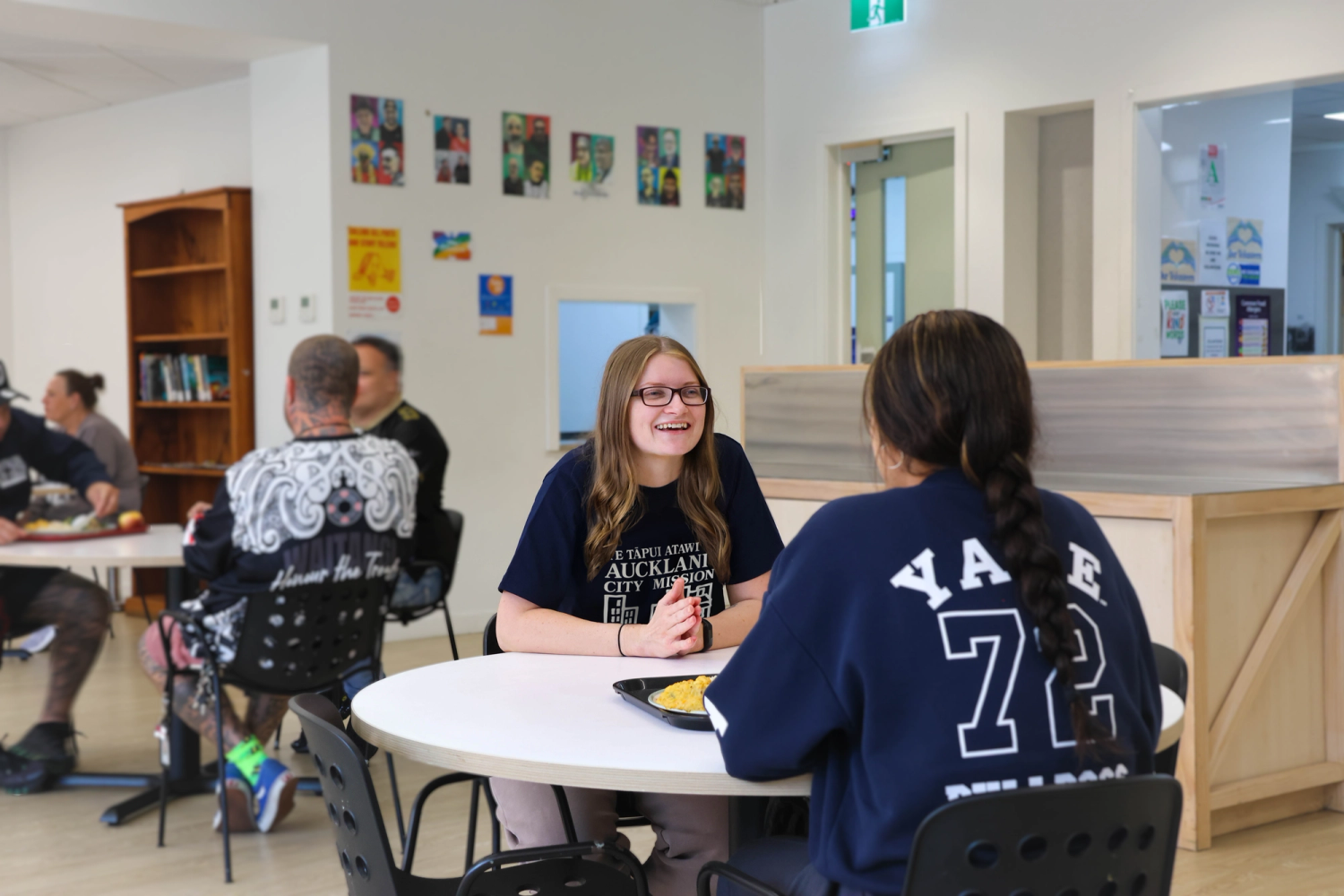
For Toni*, coming in to the Auckland City Mission – Te Tāpui Atawhai for a hot meal was the first step in navigating her way back to stability. Today she has a safe home of her own, her health is stable and she's looking forward to going back to university for a postgraduate study.
Toni had just finished her university degree and was working in media when she started to experience symptoms of schizophrenia. She tried hard to manage the condition, but as it worsened, it disrupted every aspect of her life. She was admitted to hospital and was eventually unable to continue working. Relationships with friends and family broke down.
Despite her best efforts, it became impossible to sustain housing. “I found it hard to find housing because of my schizophrenia. I had lived in all the hostels and got kicked out of them because of my schizophrenia - we’re seen as causing trouble. I fell through the cracks of the [housing] system and I had nowhere to go.”
Eventually Toni found herself sleeping rough in central Auckland. “I was homeless, living in Aotea Square for about six months. It’s a horrible situation to be in. You don’t want to be there – it just happens to you. It’s sad and it’s lonely.”
“It's basic survival when you live on the street – just trying to keep yourself warm, dry, clean and fed. And it’s harder for women to keep safe. You do it by grouping up with other women. I stayed in well-lit public areas around lots of people. That’s the only place you can stay safe and that’s where they’re trying to make us leave.”
It was while she was sleeping rough that Toni turned to the Mission for help. She began coming in to Haeata, our community dining room, for a hot, nourishing meal every morning. Through Haeata, she found so much more than food – it was here that a Mission housing keyworker reached out to Toni and helped her begin the journey off the street.
Her keyworker supported her into emergency housing – and Toni could hardly believe she was finally getting the support she needed:
“When she got me housing, I said, ‘What do you mean you got me housing?’ And she said, ‘Well, that's my job, isn't it?’ And I was like, ‘Yeah, but I didn't know anyone actually did that!’”
From emergency housing, Toni was able to move into a permanent apartment – a home of her own. “It was a really liberating feeling. It felt amazing. It felt so much better.”
The support didn’t stop once Toni was housed. Our housing keyworkers continued to walk alongside her, providing wraparound support to help her live well independently. “They help you with everything that you need. Your housing, your power, your food. They helped me to get into a routine and look after myself. They helped me start a good diet, helped me with cleaning.”
“My keyworker took me to six dentist appointments when I came off the street. I had rotten teeth because I hadn’t been able to brush my teeth.”
“The keyworkers helped me become more independent.”
Through Haeata, Toni also connected with our Calder Health Centre, where she receives ongoing medical care to manage her schizophrenia. “It was hard to manage when I was homeless. Now I get monthly injections at Calder and I’m stable.” Today, Toni has been living in her apartment for two years – the longest she’s maintained any accommodation since her schizophrenia began.
She still regularly comes back to the Mission. She’s found a non-judgmental, supportive community through Haeata and she comes in to connect with friends and take part in the programme of activities on offer at HomeGround.
“I go to the art class on Tuesday and Wednesday, weaving on Friday.” The weekly Mana Wāhine dinners in Haeata, which offer a safe space for women to come together, are a highlight of Toni’s week.
“I love going to the Mana Wāhine dinners every week. We get a good dinner and it’s really good company. It gives us time to be ourselves, to connect and just be women.”
“And I still go to Haeata for breakfast and to see friends.”
Now that Toni is in a stable place, she’s looking ahead to her future. “I’m going to go back to university next semester to do a postgraduate course. My goal is having my own production company, producing media with a Māori world view.”
“The support I’ve got from the Mission has made such a big difference to my life. I was just another statistic on the street, and now I’m actually independent again. I can get my life on track and follow my goals. Rather than being someone who is seen as a menace to society, I can participate in the world again.”