
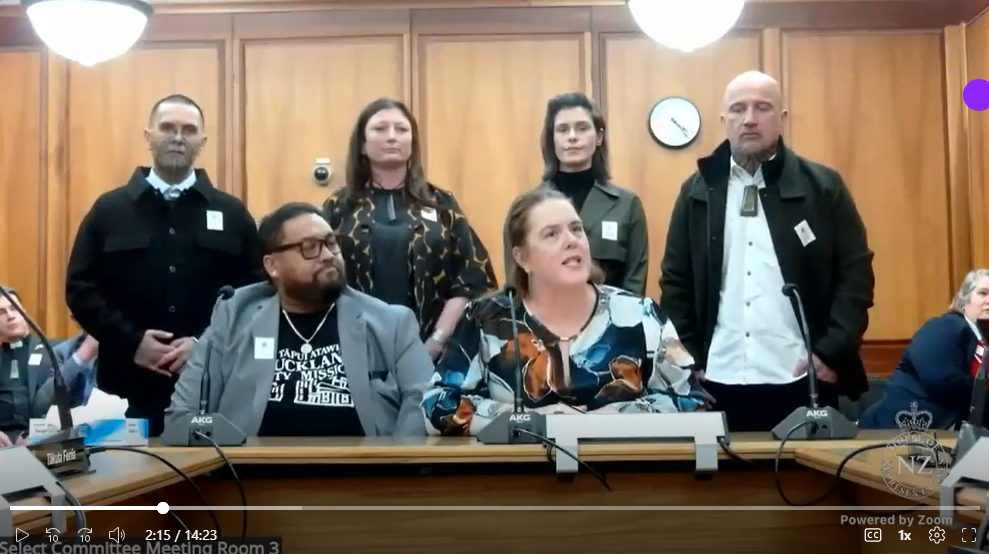
SUBMISSION ON SUMMARY OFFENCES (MOVE-ON ORDERS) AMENDMENT BILL TO THE JUSTICE SELECT COMMITTEE
SUMMARY
1. Auckland City Mission – Te Tāpui Atawhai (Mission) opposes the Summary Offences (Move-on Orders) Amendment Bill (the Bill), and submits the Justice Select Committee should recommend its rejection at the second reading.
2. The Mission considers the Bill will make unlawful the very survival behaviours that are necessary for many members of the community the Mission supports. The Mission considers the Bill contravenes the New Zealand Bill of Rights Act 1990 and Te Tiriti o Waitangi and its principles. It is also likely to be ineffective and will erode trust between the Mission and other front-line agencies and the community we serve. Its drafting will lead to perverse, illogical outcomes.
3. The Mission opposes the Bill for the following reasons:
a. It will channel unhoused people into the criminal justice system
b. It has the potential to inflict more harm and prevent people from accessing crucial services
c. It is inconsistent with the New Zealand Bill of Rights Ace 1990
d. It will disproportionally impact Māori, young people and members of the disabled community
e. It has been developed and progressed against all advice.
4. The Mission wishes to speak to its submission. The Mission also extends an invitation to the Select Committee, or individual members of the Committee, to be hosted at HomeGround, and to hear submissions from those most likely to be affected by the proposed orders.
BACKGROUND
5. For 106 years, the Mission has stood alongside those in our community who are in the greatest need. The Mission focuses on access to housing, food, and healthcare for people experiencing poverty and housing instability, while advocating for systemic change.
6. The Mission provides over 1.45 million meals to whānau per year through 33,000 food parcels, and over 90,000 warm meals at our Haeata community kitchen, often accessed by those without a home. The Misson runs inpatient managed withdrawal services, a high-needs general practice providing primary healthcare for 2,500 patients, permanent housing for 270 people, and 72 transitional housing places. The Mission provides outreach services on the streets of Auckland and a day programme for unhoused and vulnerably housed people that is connecting with up to 225 unique individuals each week.
7. The Mission continues to see rising need for our services – a growing cohort of people entering homelessness and significant barriers to accessing emergency housing.
8. The funding for responding to rough sleeping released by the government in September 2025, extended in June 2026, is warmly welcomed, but without long term sustainable investment in sufficient permanent homes and the support required to maintain tenancies, it risks becoming nothing more than a band aid.
SPECIFIC CONCERNS WITH THE BILL
1: The Bill is a direct pathway to criminal consequences for homeless people
9. It can be accepted that the Bill does not literally criminalise homelessness.1 However, as explained below, it attaches criminal consequences to resisting or breaching move-on orders that, in reality are most likely to be used in relation to people who are homeless. Many of those issued with these orders will be unable to comply 2 and this will bring them into the criminal process. We are deeply concerned by the impact this could have on our ability to provide consistency of services and build enduring relationships – if individuals are now circling the drain of the District Court system, moving in and out of jail, and facing sanctions that seems divorced from any rational punitive or protective purpose.
10. The Government’s stated objective is to address disorderly and disruptive behaviour in public places. The Mission supports that objective. Yet the Bill does not confine itself to disorderly and disruptive conduct. It extends move-on powers to begging, rough sleeping, and setting up personal possessions indicating an intent to inhabit a public place.3 These are not disorderly behaviours. They are survival behaviours – what people do when they have nowhere else to go.
11. It is important to be precise about what the existing law already covers. The offence of intimidation under the Act requires a face-to-face confrontation with an element of disagreement or hostility and an awareness that one’s actions may cause fright.
12. “Inhabiting a public place” and “rough sleeping” are not intimidating per se. The Bill institutes a lower threshold that conflates existing in public with deliberate hostile action. That has the potential to create serious issues of scope: it may capture those who are busking or dozing on a park bench, or create the risk that police are empowered to distinguish between those who look or seem more likely to fit into the category of “antisocial” and those who, in the Minister’s own words, are the “Aucklanders who deserve to feel safe and welcome”.
13. Further, the statutory drafting is concerningly imprecise. This Bill poses major interpretative issues, most significantly with proposed cl 8A(1)(f): rough sleeping or setting up personal possessions, makeshift shelters, or other structures indicating an intent to inhabit the public place.
14. “Rough sleeping” is not a formally understood term and is not defined in the Bill. The proposed text (the “or” that follows “rough sleeping”) indicates that rough sleeping is seen as different from the phenomenon of ‘setting up personal possessions, makeshift shelters or other structures’. It is then left ambiguous as to whether the final phrase (‘indicating an intent to inhabit …’) qualifies each of the compound gerunds that follow (“rough sleeping “and “setting up …”).
15. The resulting difficulties of these problems of interpretation and application are profound. Is a person who is awake nonetheless rough sleeping? What is required to prove a person intends to inhabit somewhere, as opposed to resting there temporarily? What types of ‘possessions’ count? What is the “setting up” of personal possessions with an intent to “inhabit” and is it different from just having possessions? What exactly indicates ‘'intent to inhabit the public place” as opposed to being present in it for a period? And if “rough sleeping” is intended to define the phenomenon of having no home or place to sleep, rather than actually sleeping, in what sense is the act of rough sleeping truly linked to any one particular place in which an affected person happens to be?
16. These are not just technical problems about the wording and its imprecision. They go to the very core of what is being proposed, illustrating its difficulties. They suggest that, even if homelessness is not literally being criminalised, it is indeed the phenomenon of homelessness that renders a person amenable to the orders to “move on” from a public place and thereafter to criminal charges for non compliance.
17. Further, this (along with begging) seems to be the underlying purpose of the Bill. It is true that move-on orders could be a consequence of disorderly, disruptive and intimidating behaviour. But that sort of behaviour is already targeted by the law and is amenable to police intervention, for example, under the Summary Offences Act 1981 and the Trespass Act 1980. Is it really intended that police will order a person whose behaviour is intimidating, disruptive or disorderly to simply ‘move on’ to another place? That seems an unusual response to increase safety or reduce public risk. There are already legal tools for addressing these behaviours.
18. The power to issue move-on orders is therefore likely to be used in relation to those who are begging, rough sleeping, or seen as intending to inhabit a public place – i.e. not doing anything that causes police concern as to public safety. This is the sense in which homelessness (and begging) is brought within the orbit of criminal law.
2: The Bill could lead to more harm and prevent access to services
19. The Mission recognises that it is in the interests of Aucklanders and visitors alike that public spaces are perceived as safe and welcoming for everyone, including people who are forced to sleep on the streets because there is nowhere else for them to go. Indeed, Mission outreach teams have already seen the impact of the proposed Bill, with an influx of rough sleepers to Auckland's central suburbs. People who are harder for us to find are harder for us to help. They are also less inclined to travel to HomeGround for breakfast, or medical appointments – key “front doors” in our services, from which point we are able to build relationshipswith people that can and do result in supporting people into permanent housing. The problem remains there is nowhere for people to wait, other than the street, while they wait for a place in transitional or social housing to become available.
20. The Mission supported the Government’s investment in September 2025 to support those living without stable or suitable shelter. At the time, the Government said it “can and will do more for rough sleepers.” The Mission does not believe that ordering rough sleepers and other vulnerable Aucklanders to move on will achieve or advance that shared goal.
21. The Bill states that its purpose is to “increase the public’s sense of safety”. Yet people sleeping rough are themselves among the most vulnerable members of our community and are far more likely to be victims of violent crime than the general population. The Mission records, on average, a death every fortnight among our primary care patients, almost all of whom are experiencing or have experienced homelessness. The average age at death is just 55 for men and 54 for women.
22. Many people sleeping rough remain awake through the night because they do not feel safe enough to sleep. Instead, they sleep during the day in visible public places, deliberately choosing locations with CCTV, lighting and foot traffic because they believe these offer the greatest protection from violence and theft. Move-on orders would displace people from the places where they feel safest, pushing them into darker, less visible locations where they face an even greater risk of harm. Rather than increasing safety, the Bill risks making some of our community’s most vulnerable people less safe by moving them into harm’s way.
23. The Bill will not make our city centres safer. It will not address homelessness. It will cut people off from the services – including the Mission itself – that provide the care, respect, and tailored help everyone deserves, including supporting people into permanent housing.
24. It is concerning that members of our community could be prevented, nominally over a 24-hour period, but perhaps for extended periods, from accessing health and social support services in the area the person is banned from, including the government funded (and partially provided) regional residential managed withdrawal service.
25. The Mission is especially concerned that the impact of this order will be to prevent vulnerably housed and unhoused people from accessing our purpose-built facility, HomeGround, located close to SkyCity. HomeGround has been recognised as a leading model in support for people without a home.
3: The Bill is inconsistent with the New Zealand Bill of Rights Act 1990
26. In his ‘s 7’ report, the Attorney-General determined that the Bill, in its current form, appears inconsistent with the right to freedom of expression and freedom of movement.4 The Mission does not repeat the content of this report, but supports it, save for the conclusion discussed below.
27. The Attorney-General concluded, in a footnote, that “in theory, move-on orders may be issued to the same person again and again, from one area to another…this is not a reasonable hypothetical and it can be assumed that constables will [act] in a way that is compliant with the Bill of Rights Act, and not in an oppressive manner”.5
28. The Mission disagrees. The Mission additionally considers that when a move-on order is issued repeatedly, in a short period of time, not only are the rights of the ‘moved-on’ individual to freedom of expression and freedom of movement engaged, it is arguable that carrying out the powers the Bill proposes will reach the threshold of cruel or disproportionately severe treatment.6
29. To illustrate this, take a person who at 10am on Wednesday morning is sitting on the corner of Shortland Street and Queen Street. A cruise ship is set to dock, and it is a workday. This individual, with mobility and literacy challenges, is issued with a move-on order to protect our “vibrant public spaces”. This person, unlike the group we discussed above who will be arrested for failure to comply, is able to follow the order.
30. A possible scenario is that the person then packs up their possessions and shifts up to Karangahape Road – assuming the geographic scope of the order has been limited for rights-consistency. At 5pm, a second set of police officers comes across the individual. They know a move-on order has been issued earlier in the day, but consider the grounds exist under (proposed) s 8A(1) for a second move on order. The individual moves again – it is 6pm, services are closed. This person has already been refused emergency housing on the basis of “causing or contributing to their own housing need”. The person is “new” to rough sleeping, which means they do not qualify for Housing First. Ironically, the first criteria for which is “have been sleeping rough, or in other places not designed for habitation (e.g. in cars or unconverted garages) for at least 12 months over the past three years”.
31. The unhoused person, unable to get on a bus or order an Uber, must keep walking to find somewhere to rest for the night. At 10pm, a third set of police officers approach the individual on Upper Queen Street. Despite knowing that this person has been issued two move-on orders that day, police have been called by concerned business owners, expecting action to be taken to “promote thriving urban economies”. A third order is made, or perhaps even an arrest for not following the second order. The next day, the person is still on our streets and may now be taking up time in the criminal justice system. Services have been unable to engage, as the person cannot or will not return to the central city when there is a risk of further interaction with police.
32. The Bill contains no safeguards for repeated move-on orders, demonstrating that the Bill’s consequences on those it will affect have not been thought through. Issuing a move-on order to the same person “again and again” is a clear possibility given the design of the Bill.
33. The Attorney-General’s confidence that police will exercise their powers in a Bill of Rights compliant manner is optimistic. But on the face of the Bill there is no end-point – it seems that a move-on order can be issued until the person reaches a point where there is nobody there to complain. This is particularly concerning given the lack of in-practice access to emergency housing – the main pathway available to support someone living on the street into a bed tonight. The Mission closes at 5pm. Auckland does not have a night shelter.
34. The Mission is disappointed that the Government is committing to passing this Bill in the knowledge they would be criminalising rough sleeping, a state of being exacerbated by government targets to reduce the number of households in emergency housing. The same policy settings mean that there is nowhere safe for people sleeping rough to be moved on to, if issued an order.
35. The Mission highlights the Attorney-General’s conclusion that banning individuals from staying in or returning to a specified area would prevent a person from accessing “other important premises in the relevant area such as a medical centre or church”,7 and that this is “broader than it needs to be”.8 The Mission repeats the concern that this will breach the right to freedom of movement, and submits this alone is a reason for the Bill to not progress.
36. We expect the Bill to impede access to what are genuinely life-saving services we provide at the Mission: our community dining room serves 300 meals daily, often the only hot meal someone will eat all day. Our managed withdrawal service supports people through the acute phase of withdrawing from alcohol and other drugs. Our medical centre provides free physical and mental healthcare to people with the most complex needs in Aotearoa who could not access this primary care otherwise. Our day programme is a place for people to rest, and have their needs assessed. The lack of recognition of the necessity of such places within the wording of the Bill demonstrates again the reckless and rushed nature of this law making.
5: The Bill goes against advice
37. The Ministry of Housing and Urban Development (“HUD”) made the same point clearly and repeatedly during the policy development process.9 In cross-agency correspondence released under the Official Information Act, HUD officials stated that “homelessness, rough sleeping and begging are not synonymous with anti social, criminal or intimidating behaviour, and it is important that responses distinguish between social vulnerability and other activities.” HUD recommended the explicit exclusion of survival behaviours from the definition of public disorder. That recommendation was not adopted. HUD assessed that the proposal would cause “further harm” and would shift the problem without addressing it. 38. The Ministry of Justice’s own Regulatory Impact Statement reached the same conclusion. 10 It assessed that “law enforcement responses are neither appropriate nor effective responses to behaviours that fall below the criminal threshold, particularly such behaviours involving begging, rough sleeping, and setting up personal possessions, encampments, makeshift dwellings, or other structures in public places.” The Ministry did not recommend Option Four – the option the Government adopted – and recommended retaining the status quo. The Ministry’s Offence and Penalty Vetting team “firmly assess[ed] that the use of move-on orders to address any concern in this context is disproportionate to the harm caused and will create inconsistencies in the law.”11
39. Treasury assessed that the costs of implementation outweigh the benefits. The Privacy Commissioner noted a “limited evidence base to support the policy rationale” and observed that “collecting personal information without an evidence based rationale increases the risk of the information collection being unnecessary.”12
40. There is also no credible evidence that move-on orders will work. The Regulatory Impact Statement acknowledges that “studies have found that there is no empirical evidence that move-on orders in Australia and the United Kingdom have resulted in reductions in crime rates.” Reports from Australia consistently show that move-on orders are applied in a discriminatory manner, disproportionately against people who are homeless, indigenous, young, or experiencing mental illness.
41. The Mission has no reason to believe their application in New Zealand would be different.
RECOMMENDATIONS
42. First, the Bill should not progress. Instead the existing initiatives to respond with homelessness should be allowed to have their intended effect. Alternative solutions need to be found in preference to sanctions backed by criminal prosecutions.
43. Second, if the Bill is to proceed, the following amendments should be made:
a. A longer timeframe for the Bill to come into force to allow for mechanisms, such as increased beds in emergency housing or immediate access transitional housing, or a roll-back of the restrictive criteria, to be enacted.
b. The criterion of rough sleeping and inhabiting a public place be removed entirely.
c. All persons aged under 18 must be expressly excluded from its scope.
d. An express clause that anyone issued a move-on order for rough sleeping is first offered emergency housing or a bed in immediate access transitional housing that they are realistically able to access within 24 hours. If the offer is accepted, all practical steps should be taken to support the person into their accommodation where they are able to stay until suitable permanent housing is secured.
e. Remove begging.
f. An express exemption ensuring that no move-on order can prevent a person from accessing premises operated by health and social service organisations, food providers, or housing. The Mission and organisations like it must remain accessible regardless of the scope of any order.
g. An express cap on the number of move-on orders that may be issued to any individual within any 24-hour period. If the Attorney-General considers it will not occur, there is no reason to not make it explicit in the Bill. Without this safeguard, the regime creates a material risk of conduct that engages section 9 of the New Zealand Bill of Rights. No person should be moved from location to location through day and night with no opportunity to rest.
h. A review clause be inserted to ensure an assessment of the legislation’s effects in one year’s time.
Helen Robinson
Auckland City Missioner, Manutaki and Chief Executive
Foot Notes:
1 21 May 2026, Hon Paul Goldsmith, First Reading on Summary Offences (Move-on Orders) Amendment Bill.
2 Because of the established concerns as to the necessity of accessing medical care, community pantries and organisations, places of worship and shelter, or well-lit areas with foot traffic; or because of mental and physical challenges; or a lack of trust in police and/or government agencies, the responsibility for which lies with the Crown.
3 Summary Offences (Move-on Orders) Amendment Bill (310-1), cl 4: definition of begging, and 8A(1)(e) and (f).
4 Chris Bishop Report of the Attorney-General under the New Zealand Bill of Rights Act 1990 on the Summary Offences (Move on Orders) Amendment Bill (14 May 2026) [S 7 Report]. The Attorney-General also considered that the Bill did not engage the right to be free from discrimination and freedom from arbitrary detention. The Mission notes that the brevity of this advice perhaps reflects the undue urgency this Bill is progressing with.
5 Section 7 Report, fn 14.
6 Contrary to s 9 of the New Zealand Bill of Rights Act 1990.
7 Section 7 Report at [33].
8 At [32].
9 HUD Feedback – Strengthening Responses to Public Disorder (Te Tūāpapa Kura Kāinga – Ministry of Housing and Urban Development, October 2025) (“HUD Feedback”) (obtained under Official Information Act 1982 request HUD2025-008549 to Te Tūāpapa Kura Kāinga – Ministry of Housing and Urban Development).
10 Ministry of Justice Regulatory Impact Statement – Strengthening Responses to Public Disorder (27 November 2025) (“RIS”).
11 Ministry of Justice Departmental Disclosure Statement: Summary Offences (Move-on Orders) Amendment Bill (29 April 2026) (“Disclosure Statement”).
12 Office of the Privacy Commissioner, consultation feedback on the Bill, reproduced in Disclosure Statement, at [3.5.1].